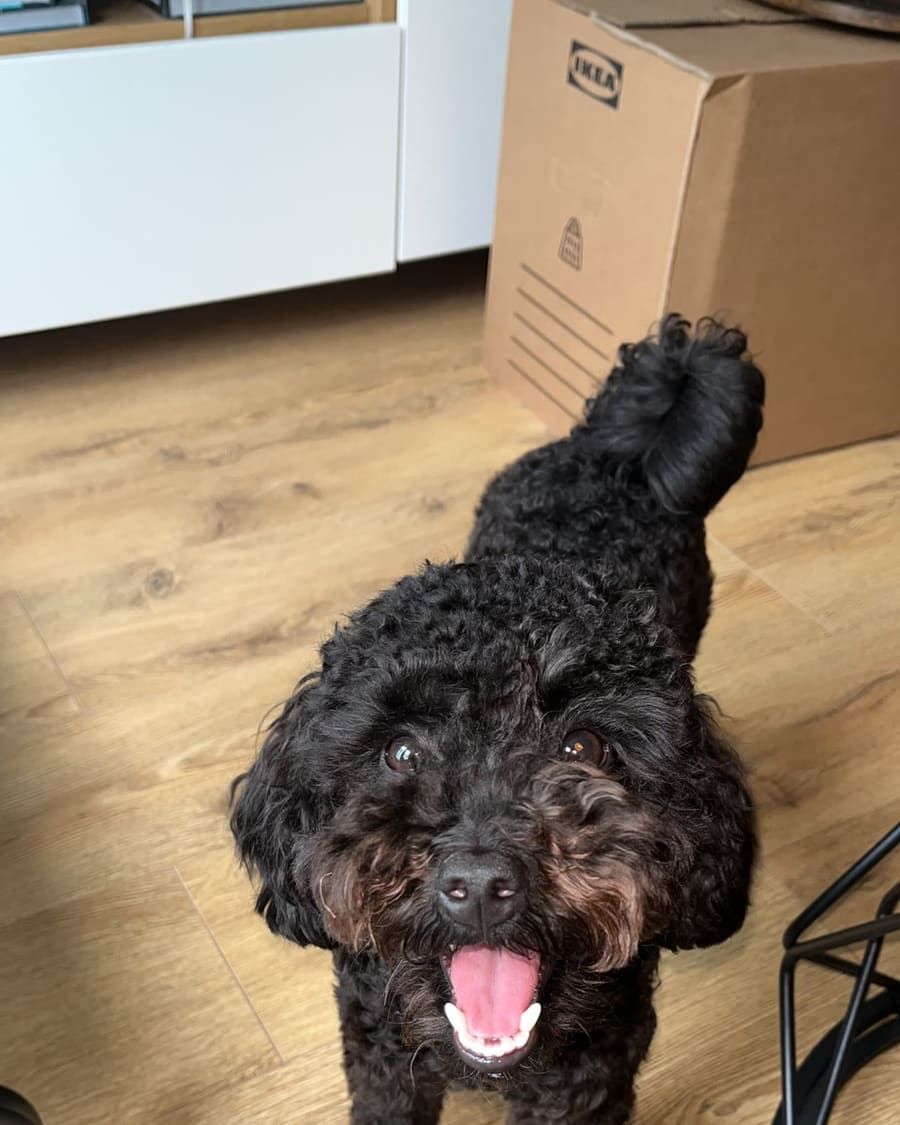
Crate Training a Toy Poodle Puppy: What Actually Worked for Rolo
Most puppies accept a crate within one to two weeks if you do it in the right order. Here's the RSPCA's four-step method, and where we nearly got it wrong.

We nearly skipped crate training altogether because the idea of putting Rolo “in a cage” felt wrong. What changed our minds was realising a crate done properly isn’t confinement, it’s the puppy’s own space, and that most of what goes wrong with crate training is people rushing the order of steps, not the crate itself.
The method that actually works
The RSPCA sets out a four-step process, and the order matters more than the speed:
- Familiarise first. Put the crate somewhere the household already spends time, door fixed open, no pressure to go in. Treats or a toy placed just inside do the work of making it interesting on the puppy’s own terms.
- Feed meals inside it. Once your puppy’s eating in the crate without hesitation, start closing the door a little longer after each meal, building up to around ten minutes.
- Build alone time gradually. Leave a favourite chew at the back of the crate and step out of the room, starting at around five minutes and working up to thirty.
- Only then, real absences. Once thirty minutes alone is comfortable, actual departures, with exercise and a toilet break beforehand, can begin.
Most puppies accept the crate within one to two weeks following this order, sleep through the night in it, and keep choosing to rest there long after the formal training’s finished.
The rule that matters more than the schedule
The RSPCA is explicit about this: a crate must never be used as punishment, and never as a “time out” for chewing or other unwanted behaviour. The moment a crate becomes somewhere a puppy gets put when they’re in trouble, it stops being the safe space the whole method depends on, and the training you’ve already done starts working against you.
Where we nearly got it wrong
We tried to skip from step one straight to a half-hour absence because Rolo seemed fine with the door closed for ten minutes at mealtimes. That was a mistake: fine with the door closed in the same room is not the same as fine with us gone, and the first real absence produced genuine distress crying, not the settling-in whining that’s normal. We went back two steps, rebuilt the alone-time stage properly, and it worked the second time. The RSPCA’s ordering exists for a reason; skipping stages because an earlier one went well is the most common way owners undo their own progress.
How long it actually took
Door-open familiarisation took about three days. Meals-in-crate with the door closing took under a week. The real gap was alone-time: just over two weeks of short, gradually extended absences before a genuine half-day departure was stress-free. Call it three weeks start to finish, which lines up with the RSPCA’s one-to-two-week estimate for the straightforward cases, plus the extra time our restart cost us.
FAQs
How long can a puppy actually be left in a crate? The RSPCA doesn’t give a fixed hours-per-month figure, but notes puppies can’t hold their bladder and bowels as long as adult dogs, who are typically comfortable for around three hours once fully trained. Build up gradually rather than assuming a number.
Is it ever okay to use the crate as a punishment, just occasionally? No. The RSPCA is explicit that crates must never be used as punishment or to prevent unwanted behaviour, since it undermines the crate’s purpose as a safe space and can set training back.
What if my puppy cries every time I leave, even weeks in? Ordinary settling whining is different from real distress. If it’s combined with signs of panic (not just crying but genuine distress), that’s worth raising with a vet or behaviourist rather than pushing through it alone, since it may point to separation anxiety rather than normal crate adjustment.
Sources: RSPCA, “How to Crate Train a Puppy,” rspca.org.uk, 2026.


